Uttar Pradesh crossed nine lakh rooftop solar installations under the PM Surya Ghar scheme, UPNEDA announced on 15 October. That is more than 3,000 MW of panels on house roofs, the highest of any state in the country. UP moved ahead of Gujarat in the first week of October and has kept the lead since.
Most families installed panels for the subsidy. Fewer know how the money actually comes back to them. That part is handled by net metering, and its fine print decides whether your solar plant saves you real money or leaves you with credits that pay almost nothing.
What UPNEDA announced
The state is adding 9 to 10 MW of domestic rooftop capacity every day, close to Australia's daily average of 10.4 MW in the first half of 2026. More than 9,500 registered vendors are doing the installation work, and the programme has created over one lakh direct jobs, UPNEDA director Ravinder Singh said.
Officials estimate that 3,000 MW of rooftop capacity generates about 1.35 crore units a day, assuming 4.5 units per kilowatt. At an indicative rate of ₹6.50 a unit, that power is worth roughly ₹8.78 crore a day. Actual output varies with weather and upkeep.
Applications under the scheme are open until 31 March 2027.
The subsidy you get if you apply now
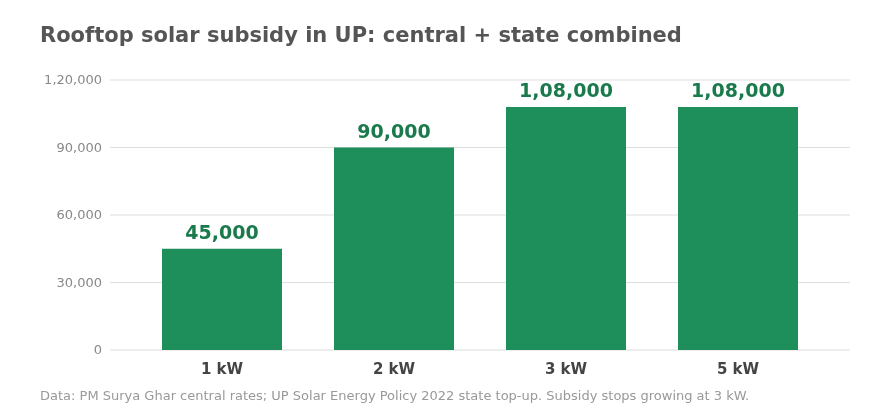
Two subsidies add up for a household in UP. The centre pays ₹30,000 per kW for the first 2 kW and ₹18,000 for the third kW, stopping at ₹78,000. UP adds its own ₹15,000 per kW under the UP Solar Energy Policy 2022, capped at ₹30,000 per consumer.
| System size | Central subsidy (₹) | UP top-up (₹) | Total (₹) |
| 1 kW | 30,000 | 15,000 | 45,000 |
| 2 kW | 60,000 | 30,000 | 90,000 |
| 3 kW | 78,000 | 30,000 | 1,08,000 |
| Above 3 kW | 78,000 | 30,000 | 1,08,000 |
Notice the caps. A 5 kW system gets the same ₹1,08,000 as a 3 kW one, so the subsidy per kilowatt falls quickly beyond 3 kW. The central share comes through the national portal; the state share is paid by UPNEDA after commissioning, with a 15-day release target from the joint commissioning report. Housing societies get a separate central rate of ₹18,000 per kW for common facilities, up to 500 kW.
How net metering actually pays
Net metering is available to domestic (LMV-1) and metered agricultural (LMV-5) consumers in UP. The rules come from the UPERC Rooftop Solar PV Grid Interactive Systems (Gross/Net Metering) Regulations, 2019, as amended in 2022, 2023 and 2025.
The working is simple. In each billing period, the units your panels export first cancel the units you import. Whatever export is left over carries forward as a credit balance until 31 March. At the end of the settlement year, any credit still unadjusted is paid at ₹2 per unit, and the balance resets to zero on 1 April.
Two things catch people out. First, fixed charges and duties keep appearing on your bill even in a month when your solar covered all your units. Credits reduce the unit charge only. Second, the year-end payout of ₹2 a unit is far below what you pay for grid power. A system sized to your own consumption earns more than an oversized one that exports a big surplus.
The regulations also require your bill to show units generated, units exported, units imported, net units billed and credits carried forward. If those lines are missing, ask your discom to fix the format.
Other limits worth knowing
Your plant cannot be bigger than your sanctioned load, so check the load printed on your bill before you pick a size. If you want more capacity, apply for load enhancement first. Also, the total rooftop capacity on one distribution transformer is capped at 75% of its rating, approved first come, first served. If your local transformer is already full, your application waits until the network is augmented. For up to 10 kWp of new capacity after augmentation, you pay nothing; beyond that there is a one-time ₹1,000 per kWp.
What you should do
If you are planning solar this winter, start by reading the sanctioned load on your latest bill. Register on the national portal pmsuryaghar.gov.in, pick a vendor registered in UP, and get the full price, including the net meter and structure work, in writing. The subsidy window closes on 31 March 2027.
If you already have panels, open your current bill and check the five solar lines mentioned above. And if you want to see what your grid units cost today, run your bill through our bill calculator before and after solar, the difference is your real saving.
Sources
- ETEnergyWorld: UP crosses 9 lakh rooftop solar installations (UPNEDA, 15-16 October 2026)
- Free Press Journal: UP overtakes Gujarat under PM Surya Ghar (5 October 2026)
- UPERC Rooftop Solar PV Grid Interactive Systems (Gross/Net Metering) Regulations, 2019, amended up to 2025
- Uttar Pradesh Solar Energy Policy 2022 (state top-up)
- National Portal for Rooftop Solar: pmsuryaghar.gov.in