New connection estimate after January 2026 is higher and looks completely different, and most consumers and even field staff are not able to match it with earlier bills. This is happening because UPERC has changed how the estimate is prepared — not just the rates
Why did UPPCL change the connection cost system in 2026?
Earlier, every consumer got a different estimate. The JE would visit the site, measure how far the line needs to go, calculate material, and then prepare the estimate. Two neighbours in the same colony could get different figures. There was no standard — delay was common, arguments were frequent, and sometimes the consumer had no way to verify if the amount was correct.
UPERC officially acknowledged this in the Press Release dated 31 December 2025 — the new system was introduced "to avoid delay in release of new connections and to eliminate the requirement of site inspection and preparation of estimates for each and every case individually."
The fix: make the charges fixed, standard, and transparent — so no one can dispute them.
1. The biggest change: Fixed Supply Affording Charge (SAC)
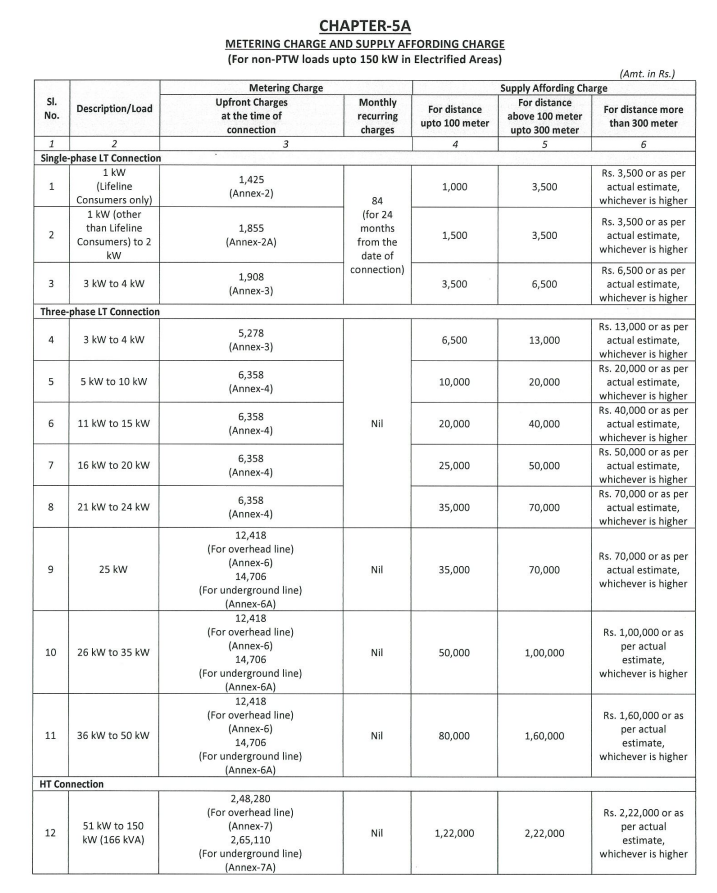
Earlier, a separate line estimate was prepared for any consumer living more than 40 metres from the existing electricity line. Now UPERC has introduced a fixed charge called Supply Affording Charge (SAC) — and it covers all connections up to 150 kW where the nearest distribution line is within 300 metres.
- What this means for a consumer: No separate estimate, no back and forth with the JE. Just pay a fixed amount based on your load and distance from the nearest line — and get the connection.
- What this means for field staff: Visit the site and prepare an internal departmental estimate for execution of the work required to provide electricity to the applicant. This estimate is not related to the applicant. The consumer only pays the applicable fixed SAC slab amount.
- Supply Affording Charge (SAC) slabs are defined on two factors:
- Distance: There are two slabs — 0 to 100 metres and 101 to 300 metres.
- Load: The slabs are divided into up to 50 kW and 51 kW to 150 kW.
- Download the detailed Metering charges and Supply Affordable Charges -
Note: If your premises is more than 300 metres from the nearest line, then an actual estimate is prepared and you pay whichever is higher — the slab amount or the actual cost.
People in unelectrified colonies do not pay Supply Affording Charge
If you live in a newly developed colony where UPPCL has not yet laid any poles or wires, you will not be charged the Supply Affording Charge. The infrastructure cost for such colonies is already being recovered through per-square-foot development charges, which is Rs. 70/square meter.
Residents of unelectrified colonies only pay the Metering Charge — nothing more for line work.
The same relief applies to residents of multi-storey buildings with multi-point connections. No SAC for them either — only the Metering Charge applies
2. Processing Fee for Line Shifting — A Completely New Chapter
The Cost Data Book 2025-26 book introduces an entirely new Chapter 3: Processing Fee for Line Shifting, which did not exist before.
| Infrastructure to be Shifted | Processing Fee (₹) |
|---|---|
| LT Line / PTW Connection | 1,000 |
| 11/0.4 kV Transformer | 5,000 |
| 11 kV Line | 10,000 |
| 33 kV Line | 15,000 |
| 33/11 kV Sub-station Shifting | 25,000 |
Note:
- The processing fee shall be non-refundable and non-adjustable.
- In case of more than one shifting works required on the same place, the consumer shall pay the processing fee only for the work with maximum processing fee.
3. 11 kV connection limit increased for larger consumers
Earlier, connections on 11 kV voltage were allowed only up to 3 MVA load. The new book raises this limit to 4 MVA, in line with the 13th Amendment to the UP Electricity Supply Code 2005. This means larger commercial and industrial consumers can now take 11 kV connections without needing to go to 33 kV — simpler infrastructure, lower cost.
4. 3-phase connection on 3 kW — now allowed for the first time
Earlier, a 3 kW or 4 kW load meant single-phase connection only. No choice, no option.
The 2025-26 book changes this. For 3 kW and 4 kW loads, the consumer can now request either single-phase at 230 V or 3-phase at 400 V — as per the UPERC Tariff Order dated 22.11.2025. The Metering Charge is different for both: ₹1,908 for single-phase and ₹5,278 for three-phase (overhead connection).
This is useful for small workshop owners or anyone running equipment that needs 3-phase supply but whose sanctioned load is only 3–4 kW. Earlier they had no official route — now they do.
Below 3 kW — single-phase only, no change. Above 5 kW — 3-phase was already the default. This new option is only for the 3 kW and 4 kW band.
5. Farmers now have a new option for tube well connection
Earlier, a farmer wanting a pump connection had to take supply through a shared 25 kVA transformer — meaning if three or four farmers shared one transformer, voltage problems and complaints were common.
The new Cost Data Book now allows farmers to take an independent connection through:
- A 3-phase 16 kVA transformer for their own exclusive supply
- Or a single-phase 10 kVA transformer for smaller loads
This is especially useful for farmers tired of shared transformer problems. The cost for both options has been fixed in the new book.
Also, for farmers still sharing a 25 kVA transformer, the shared cost of the transformer has been reduced from 50% to 33.3% — a small but welcome reduction.
6. Smart meter cost is now part of your connection charge
Earlier, meters were handled separately and there was no fixed cost defined clearly. From January 2026, every new connection will have an AMI-compatible smart meter — and its cost is built into what is now called the Metering Charge (earlier known as Fixed Service Line Charge).
For a single-phase home connection, the smart meter costs ₹2,800. You have two options:
- Pay ₹1,000 at the time of application, and the remaining ₹1,800 comes as ₹84 per month for 24 months in your electricity bill
- Or pay the full ₹2,800 upfront at application itself — this saves you the interest cost
7. The Book Now Has a Built-In Expiry and Auto-Escalation
The 2019-20 book had no validity clause. It just ran indefinitely — six and a half years, as it turned out — while material costs climbed uncontrolled. The 2025-26 book fixes this structurally: it is valid for two years, and after the first year, material rates (excluding meter costs) automatically escalate by the WPI change of the preceding 12 months for the second year. If a new book is delayed beyond two years, annual WPI escalation continues until the replacement is approved. Consumers and staff need to check the applicable year's escalated rates, not just the base book figures.
8. What about the rate increases?
- Roughly 20–21% up across all material items — consistent with WPI movement over the 2019–2025 period. A few representative figures:
| Item | 2019-20 | 2025-26 | Change |
|---|---|---|---|
| ST Pole 11 Mtr. | ~₹14,500 | ₹17,492 | +21% |
| 25 kVA Transformer | ~₹71,500 | ₹86,157 | +21% |
| LT 3-Phase line/metre | ~₹1,020 | ₹1,233 | +21% |
| 11 kV line/metre | ~₹670 | ₹810 | +21% |
- Processing fees went up more sharply — this was a policy decision, not WPI
- Security Deposit: For most domestic, PTW, Public lighting, and Institution connections — no change at all. The security deposit for a regular domestic connection (LMV-1) is exactly the same as before. If you run a small factory or industrial unit (LMV-6), your security went up nearly 50%. And if you are on a prepaid smart meter, you pay no security at all. Non-Industrial Bulk Load HV-1 (Private, 11 kV+), Security deposit increased to ₹5,000/kVA by 11%.
- Overall, expect your total connection cost to be 15 to 25% higher than an equivalent estimate from 2019-20. Commercial applicants will feel the processing fee increase more than domestic ones.
9. Five new annexures cover items with no previous equivalent:
- LT AB Cable rates (Annexure-13A)
- 11 kV Ring Main Unit costs (Annexure-25)
- Dry Type Transformer rates (Annexure-27)
- Smart Meter rate schedule (Annexure-29)
- 11 kV Independent Bay cost at ₹6,60,984 (Annexure-30)
Download Cost Data Book 2025-26
Frequently Asked Questions (FAQ)
Q: My connection was applied before January 2026 but not released yet. Which rates apply to me?
The old 2019-20 rates. As per Chapter 5, Note 23 of the new Cost Data Book, connections already under process before the new book's effective date will be completed on the old terms.
Q: I was charged more than ₹2,800 for a smart meter before January 2026. Will I get a refund?
UPERC has specifically mentioned in point 18 of the Press Release that a separate order will be passed to settle excess smart meter charges recovered from consumers. Watch for that order.
Q: Does the fixed SAC mean I pay the same amount regardless of how far my house is from the line — as long as it is within 300 metres?
No — there are two slabs. Within 100 metres you pay one fixed amount, and 101 to 300 metres you pay a higher fixed amount. Beyond 300 metres, an actual estimate is prepared.
Q: My colony is newly built and has no electricity infrastructure yet. Do I still pay SAC?
No. Residents of undeveloped or unelectrified colonies pay only the Metering Charge. The infrastructure cost is recovered through development charges — charging Supply Affording Charge on top is not allowed.
Q: Does the Supply Affording Charge (SAC) replace all line charges, or only some?
It replaces variable line charges for non-PTW connections up to 150 kW in electrified areas within 300 m. Beyond 300 m, PTW connections, and HT connections above 150 kW follow Chapter 5B with actual estimates.
Q: Who bears the cost of strengthening an existing LT main to give me a connection?
The licensee — this is now explicit in the book. For connections within 300 m, no cost for strengthening or converting existing LT mains is payable by the consumer.
Q: Will these rates change before the next Cost Data Book?
Yes — after one year from January 2026, material rates escalate automatically by WPI. Check the current escalated rates when reviewing any estimate issued after January 2027
Q: How is the distance measured for Supply Affording Charge?
The book is very specific about this. The distance is not measured as a straight line from your premises to the nearest pole. It is measured as the shortest clear wire route distance between two specific points: nearest distribution mains and the place where meter is to be installed. The book says clearly: "fraction of a metre shall be ignored" while measuring this length.
Q: For a PTW (private tube well / kisan pump) connection, does the 300 metre Supply Affording Charge rule apply?
No. PTW connections are completely separate. They follow their own fixed package rates under Annexures 1, 1A, 1B, and 5 depending on the transformer size and whether the transformer is being installed or not. The 300 metre SAC concept of Chapter 5A does not apply to PTW connections at all.
Q: If both an LT line and HT line are nearby, which one counts for measuring distance for an LT connection?
For an LT connection (up to 50 kW), the distance is always measured from the nearest LT main — not the HT line. The Cost Data Book says distance is measured from the "nearest available distribution mains" — it does not specify LT or HT explicitly. However, Notes 11 and 12 of Chapter 5 make clear that LT connections are served by extending LT mains — meaning in practice the reference point will be the nearest LT infrastructure.
Have a question about your estimate? Ask here: bijlibabu.com/question/