
From Friday, 23 October, checking teams of the city's electricity administration have started visiting homes of consumers with unpaid bills in Lucknow. Big defaulters have been given a final warning. Where arrears stay unpaid, the connection is being cut, and the bill then has to be cleared with a penalty and extra charges added on top.
If you have a pending bill, or a bill you believe is wrong, this is the week to know what the department can do, and what it cannot do without following steps written in law.
What the drive is
According to a News18 report of 23 October, the department first requests defaulters to clear their dues. Ravi Agrawal, chief engineer of the Lucknow middle zone, said a checking campaign began on Friday and big defaulters were being given a final warning. Early checks also caught some consumers drawing power directly from poles, and action is being taken against them separately.
The department's own advice: pay the outstanding bill before the cut. After disconnection, the same bill comes back bigger, with penalty and added charges on top of the arrears.
The 15 day notice is a legal requirement, not a courtesy
Disconnection for non-payment is governed by Section 56 of the Electricity Act, 2003. A licensee cannot cut supply without giving at least fifteen clear days' notice in writing. The UP Electricity Supply Code adds the detail: the notice carries a disconnection date, and that date cannot be earlier than 15 days. Only an authorised officer can disconnect, usually by removing the meter or disconnecting the line at the pole.
Two protections sit in the same law. If you dispute the bill as excessive, you can deposit under protest the smaller of two amounts: the claimed sum, or your average monthly charge of the preceding six months. Once that deposit is made, the supply is not cut while the dispute is decided. And under Section 56(2), a sum that was not shown continuously as recoverable arrears cannot be recovered after two years from the date it first fell due.
What a delayed bill adds: the surcharge maths
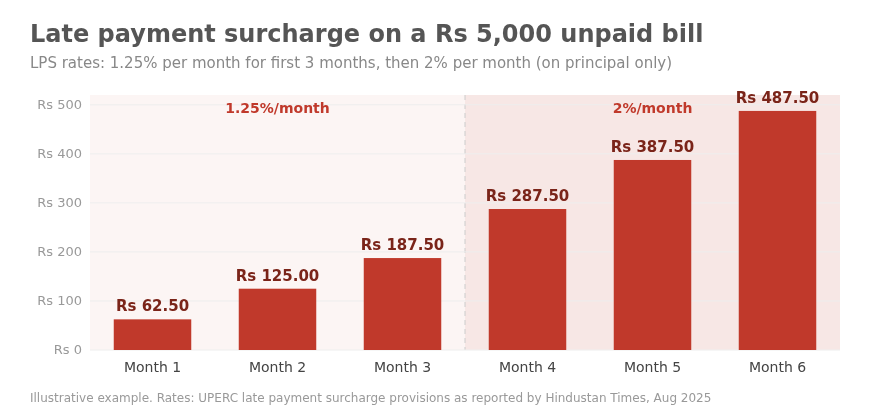
Waiting is not free. UPERC's tariff provisions levy late payment surcharge at 1.25% per month for the first three months of delay and 2% per month after that, calculated proportionately on the unpaid bill amount, excluding the surcharge itself. It does not compound, but it does not pause either.
On an unpaid principal of ₹5,000, the build-up looks like this (illustrative):
| Months unpaid | Surcharge added | Total payable |
| 1 | ₹62.50 | ₹5,062.50 |
| 3 | ₹187.50 | ₹5,187.50 |
| 6 | ₹487.50 | ₹5,487.50 |
To see how this changes your own case, put your figures in the bill calculator before you decide to wait.
If the connection is already cut
The Supply Code sets a clock for reconnection too. You apply at the subdivision office with a copy of the notice, the receipt of dues paid and the prescribed disconnection and reconnection fee. Supply must return within 24 hours of the complete application. If the service cable has to be re-erected, the window is 48 hours.
What you should do
- Check your account on the UPPCL portal or app today. If arrears or a crossed due date are sitting there, clear them before a notice arrives. The drive is targeting big defaulters first, but surcharge runs on every delayed bill.
- If your bill looks wrong, do not ignore the notice. Deposit under protest the smaller amount, keep the supply on, and take the dispute forward. The guide to defective bill codes tells you what to look for on the bill itself.
Sources
- News18 Hindi, "बिजली बकाएदारों का अब कटेगा कनेक्शन", 23 October 2026
- The Electricity Act, 2003, Section 56 (India Code / Indian Kanoon)
- UP Electricity Supply Code, 2005 (as amended), UPPCL, clauses 4.39 and 8.1
- Hindustan Times, Lucknow, on UPERC late payment surcharge provisions (1.25% for three months, 2% thereafter)