The night of 5 November, an elderly couple died in their sleep in Sadabad, Hathras. The chief fire officer said a short circuit probably started the blaze, and the clothes the family had stored for Diwali fed it. The couple died of suffocation, not burns.
That was not the only one. Three shops burned in Barigavaan in Lucknow the same night. A day earlier, a projector-room short circuit filled an auditorium at Galaxy Blue Sapphire Mall in Greater Noida with smoke; 10 to 15 people got out safely. On 2 November, furniture shops on Delhi Road in Hapur caught fire, with a short circuit suspected there too. Four fires in five days, all in UP, all traced back to electricity.
This is also the week room heaters come out of storage. A heater is the heaviest load most homes put on a wall socket all year, and wiring faults that sat quiet through summer become fires exactly now. Here is what your wiring can actually carry, and the checks worth ten minutes tonight.
The size of the problem
Fire data in India runs electrical. The NCRB's Accidental Deaths and Suicides in India report for 2024 counted 1,042 fire accidents caused by electrical short circuits, with 1,012 deaths. That is roughly 17 per cent of all fire-accident deaths in the country that year. Six out of ten fire deaths happened in homes.
The Uttar Pradesh Fire Services' own safety page says about 60 per cent of fires are of electric origin, listing short circuits, overheating and overloading first among the causes. In winter, all three come together in one room: an old socket, a 2,000 watt heater and eight hours of running.
What a heater actually asks of your wiring
Divide watts by 230 and you get the current a device pulls. That number decides whether your socket survives it.
| Appliance | Rated power | Current at 230 V | On a 6 A socket? |
| Halogen heater, 3 tubes | 1,200 W | 5.2 A | Fits, but alone |
| Fan heater on high | 2,000 W | 8.7 A | No |
| Oil-filled radiator | 2,000 W | 8.7 A | No |
| Storage geyser | 2,000 W | 8.7 A | No |
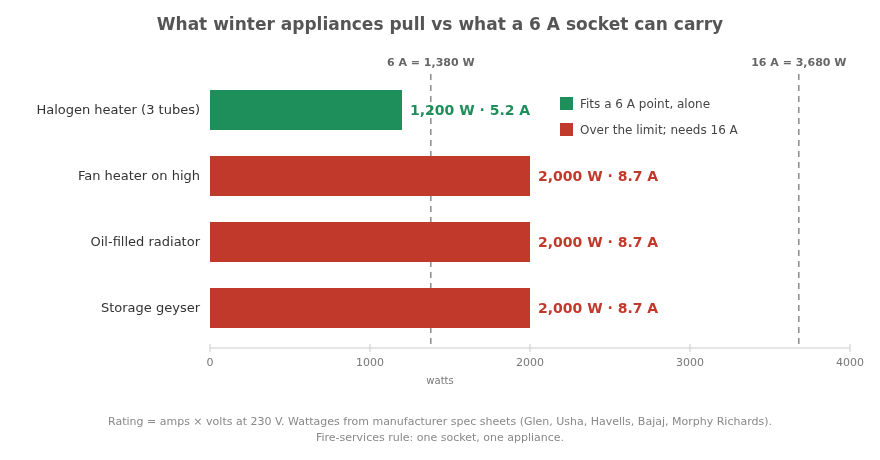
A normal socket and plug in an Indian home is rated 6 A, which at 230 V carries about 1,380 watts. The halogen squeezes under that with 180 watts to spare, as long as nothing else shares the point. A fan heater or oil radiator pulls 8.7 A, well past the socket's rating. These, like geysers, belong on a 16 A point, which carries about 3,680 watts.
The bill follows the watts. A 2,000 W fan heater running three hours a day adds about 6 units a day, or 180 units a month. For an urban home already in the 151-300 unit slab, those extra units bill at about Rs 6.00 each under the FY 2026-27 tariff, so the heater alone can add around Rs 1,080 to the month. You can put your own units into the site's bill calculator to see your case.
The extension board trap
The spike guard under the TV is rated 6 A. Total. Everything plugged into it shares that 1,380 watt ceiling, and a heater blows past it on its own. Electrical sellers print the warning plainly on their own products: do not use ordinary multiplugs with heavy-load appliances like heaters, irons or geysers. A heater on a board can scorch the plug and the socket behind the wall before anything trips.
The fire services' rule is one socket, one appliance. The same guidance adds: never run wires under carpets where they get crushed, never leave bare or taped joints, and buy only ISI-marked appliances.
Old fuse boards, and the MCB that keeps tripping
Many UP homes still run on kit-kat fuses. The fuse wire must match the rating printed on the packet and the cable behind it. The one thing a blowing fuse never needs is thicker wire. People push in a strand of cable copper, or a nail, to stop the nuisance. That turns the wire inside the wall into the fuse. A cable of 1.5 sq mm carries roughly 13 A; if the protection sits above that, the cable runs hot for hours with nothing to stop it.
An MCB does the same job with a reset switch, and it trips at a factory-set level nobody can raise. If yours trips every time the heater starts, that is a fault announcing itself, not a faulty breaker. A DISCOM safety advisory for consumers says it flatly: never fit fuses of higher capacity. Get the circuit checked instead.
Five warning signs to act on
Electricians and power company safety pages list the same signals, and every one of them shows up before a fire, not after.
1. A tingling feeling when you touch a plug, switch or appliance body.
2. A faint rubbery or burning smell near a switchboard.
3. Socket plates warm to the touch, or browned around the pin holes.
4. Lights that flicker or dim when the heater or geyser switches on.
5. An MCB that trips repeatedly on the same circuit.
Any one of these means stop using that point and call an electrician. The Bureau of Indian Standards' electrical code guidance says wiring work should go to a licensed contractor, not to the nearest quick fix.
If a fire does start
Switch off the mains first if you can reach it safely. Never pour water on an electrical fire; use dry sand or a CO2 extinguisher, both of which the fire services recommend for live equipment. Then call 101. The Hathras couple had no such chance because the fire spread while they slept, which is the strongest case for switching heaters off at the wall before bed and never leaving one running in an empty room.
What you should do
1. Tonight, before the first heater run: heater straight into a wall socket, nothing else on that point, 2,000 W models only on 16 A points, no board, no daisy chain.
2. Watch the first evening. Flickering lights, a tripping MCB or a warm plug on night one tells you the wiring needs an electrician before winter deepens. And keep your total load within your sanctioned load, as the CEA's consumer advisory for power consumers puts it; the connection estimate explainer on this site shows how that number is fixed.
Sources: PTI and Hindustan Times, Hathras fire, 5 Nov 2026 (https://hindustantimes.com/india-news/elderly-couple-burnt-to-death-in-house-fire-in-ups-hathras-short-circuit-suspected-101793852473560.html); ANI, Greater Noida mall smoke, 6 Nov 2026 (https://aninews.in/news/national/general-news/10-15-people-evacuated-after-short-circuit-filled-auditorium-with-smoke-in-greater-noida20261106013707); ANI, Hapur warehouse fire, 2 Nov 2026 (https://republicworld.com/india/hapur-fire-massive-blaze-engulfs-furniture-shops-near-cng-station-firefighters-battle-flames-after-suspected-short-circuit-2026-11-02-140233); Amar Ujala, Lucknow Barigavaan shop fire, 6 Nov 2026 (https://www.amarujala.com/lucknow/fire-breaks-out-in-three-shops-due-to-a-short-circuit-lucknow-news-c-13-lko1096-1997791-2026-11-06); NCRB, Accidental Deaths and Suicides in India 2024, fire accidents tables (https://www.ncrb.gov.in); UP Fire Services electrical safety page (https://uppolice.gov.in/pages/en/topmenu/police-units/fire-services/en-about-us-fire-services); Delhi Fire Service, fire safety precautions against electricity (https://dfs.delhi.gov.in/dfs/fire-safety-precautions-against-electricity-0); manufacturer specs for heater wattages: Glen and Usha halogen 1,200 W, Havells/Orpat/Bajaj fan heaters 2,000 W, Morphy Richards OFR 2,000 W (https://glenindia.com/blogs/news/guide-oil-filled-vs-halogen-vs-fan-heaters-which-is-better; https://www.croma.com/morphy-richards-ofr-900+-2000w-oil-filled-radiator-room-heater-with-9-fins-tip-over-safety-switch/p/263702); 6 A and 16 A ratings and fuse-wire guidance, electrical supplier technical guides (https://www.vinayakelectricals.com/best-extension-board-brand-in-india; https://www.vinayakelectricals.com/kit-kat-fuse); MSEDCL consumer electrical safety do's and don'ts (https://www.mahadiscom.in/wp-content/uploads/2019/03/Do_Dont_for_Safety.pdf); CESC electrical safety page, warning signs (https://www.cesc.co.in/index.php/safetyInfo); CEA consumer advisory, Times of India, 17 Jul 2026 (https://timesofindia.indiatimes.com/city/lucknow/stay-within-sanctioned-load-report-any-load-increase-cea-advisory-for-power-consumers/articleshow/132447818.cms); UPPCL public notice, UPERC approved tariff FY 2026-27.