

On 13 October 2026, the UP Electricity Regulatory Commission (UPERC) approved ten power purchase agreements for solar plants that will supply electricity to UPPCL through agricultural feeders and substations. The ten projects add up to 19.7 MW, and the approved rates sit between ₹2.91 and ₹2.99 per unit. SolarQuarter reported the order first on 14 October, and Construction World and Indian Masterminds followed with details on 21 October, so most consumers are reading about it only now.
One number is worth remembering: ₹2.91. That is what UPPCL will pay for a unit from the cheapest of these plants, a price discovered through competitive bidding. It shows how inexpensive large solar has become for the state, and why the scheme behind these plants keeps growing.
What UPERC actually approved
The order came on Petition No. 2412 of 2026, filed jointly by UPPCL and UPNEDA, the state's renewable energy agency. The ten projects fall under Component C-2 of the PM-KUSUM scheme. Each plant is a grid-connected solar photovoltaic unit tied to a segregated agricultural feeder or a distribution substation.
UPNEDA ran the procurement through tariff-based competitive bidding. Developers quoted rates, a bid evaluation committee picked the winners, letters of award followed, and the signed agreements then went to UPERC for approval. With the approval in hand, the developers can proceed to construction and grid connection. UPERC has also asked them to complete work on time.
One caution: an approved PPA is not a running plant. The 19.7 MW counts towards the state's solar supply only after the projects are built and commissioned.
Who got what, and at what rate
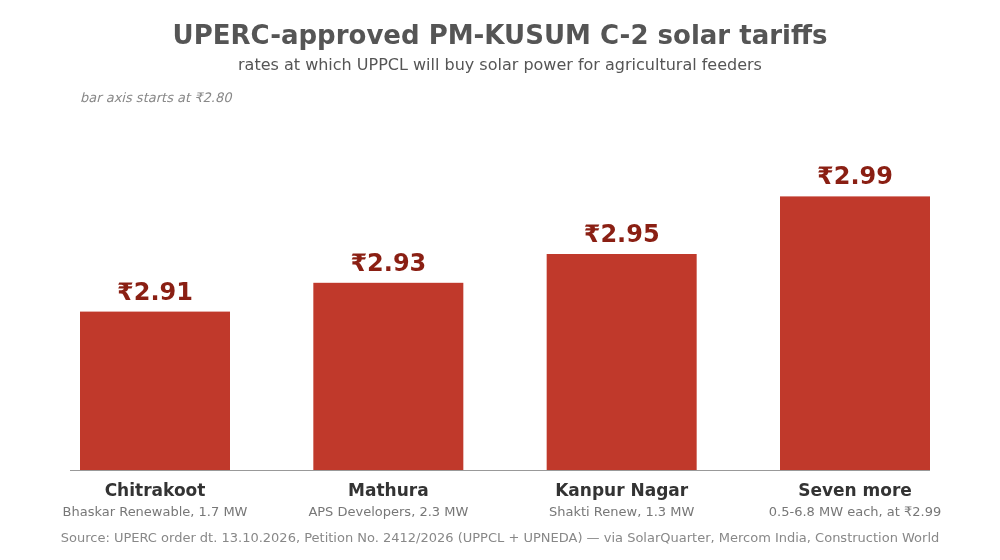
Three projects were named with their capacities and rates in the reports. Bhaskar Renewable Energy's 1.7 MW plant in Chitrakoot cleared at ₹2.91 a unit, the lowest in the batch. APS Developers' 2.3 MW Mathura project came in at ₹2.93, and Shakti Renew's 1.3 MW Kanpur Nagar project at ₹2.95. The remaining seven projects were approved at ₹2.99.
| Developer | District | Capacity | Approved rate |
| Bhaskar Renewable Energy | Chitrakoot | 1.7 MW | ₹2.91 per unit |
| APS Developers | Mathura | 2.3 MW | ₹2.93 per unit |
| Shakti Renew | Kanpur Nagar | 1.3 MW | ₹2.95 per unit |
| Seven more projects | Hapur, Amroha, Mathura, Saharanpur and other districts | 0.5 to 6.8 MW each | ₹2.99 per unit |
To see what these rates mean in money, take a plant that supplies 10 lakh units to UPPCL in a year. The bill for that supply works out as follows.
| Approved rate | UPPCL's cost for 10 lakh units |
| ₹2.91 per unit | ₹29,10,000 |
| ₹2.93 per unit | ₹29,30,000 |
| ₹2.95 per unit | ₹29,50,000 |
| ₹2.99 per unit | ₹29,90,000 |
The spread between the cheapest and the dearest rate is 8 paise a unit, or ₹80,000 over 10 lakh units. That is small on one feeder, and not small when the utility buys for hundreds of feeders across the state.
What Component C-2 means on the ground
PM-KUSUM, short for Pradhan Mantri Kisan Urja Suraksha evam Utthan Mahabhiyan, is the Centre's scheme for de-dieselising the farm sector and lifting farm incomes. It has three broad parts.
Component A lets farmers set up solar plants up to 2 MW on barren or fallow land and sell the power to their DISCOM at a rate fixed by the state regulator. Component B funds standalone solar pumps, with a central subsidy of up to 30 or 50 per cent of the cost. Component C solarises existing grid-connected farm supply. Its C-1 track solarises individual pumps, while the C-2 track covered by this order solarises at the feeder level.
Feeder-level solarisation means the solar plant serves a whole agriculture feeder. When the sun is up, pumps on that feeder draw solar power instead of conventional supply. Farmers get daytime electricity for irrigation, and the state buys clean power at a fixed, known rate. MNRE's national dashboard had counted over 35 lakh sanctions under feeder-level solarisation as of 30 September 2026, of which about 17.18 lakh were marked solarised. UP's ten new agreements are a small slice of that national push.
Why a bill-paying consumer should care
Agriculture supply in UP is heavily subsidised. The state government and the utility together carry the gap between what farm supply costs and what farmers pay. Every rupee saved on power purchase for agricultural feeders eases that burden, and over time it trims the pressure that shows up in your own bill as fuel surcharge and tariff revisions.
This does not mean your bill falls next month. Power purchase blends many sources and older contracts run for years. But direction matters. Long-term solar contracts at ₹2.91 to ₹2.99 a unit point the right way for a utility whose fuel costs have kept the surcharge line busy. If you want to see that line yourself, our earlier explainer on the FPPAS row in your UPPCL bill walks through it line by line.
The pipeline is much bigger than 19.7 MW
These ten agreements come out of a much larger tender. UPNEDA floated it in July 2024 for 3,205 MW, and later revised it to 2,553.5 MW after rechecking substation and feeder capacities. The bidding drew 153 bidders for 494 substations covering 1,529.1 MW. Letters of award have gone out for 566 substations totalling 1,686.4 MW.
The ten PPAs cleared this month are the first regulatory approvals reported from that queue. If the pace holds, similar orders will keep arriving, and each one adds low-cost daytime supply to the agriculture network.
What you should do
If you farm in or near Chitrakoot, Mathura, Kanpur Nagar, Hapur, Amroha or Saharanpur, ask at your sub-division office whether your feeder is on the solarisation list, and check your pump's eligibility under PM-KUSUM with UPNEDA or the designated district department. Keep your account ID and checking number handy when you visit.
If you pay a domestic or commercial bill, open your latest bill and read the fuel surcharge row, then estimate your monthly energy cost with our bill calculator. Those two numbers make news like this order concrete, because every paisa saved on power purchase is a paisa not passed on.
Sources:
- Indian Masterminds: UPERC approves 19.7 MW solar projects (21 Oct 2026) — https://indianmasterminds.com/news/uperc-approves-19-7-mw-solar-projects-uttar-pradesh-244281/
- Construction World: UP to procure solar at ₹2.91 per unit (21 Oct 2026) — https://www.constructionworld.in/energy-infrastructure/power-and-renewable-energy/uttar-pradesh-to-procure-solar-power-at-rs.-2.91-per-unit/99092
- SolarQuarter: UPERC approves 19.7 MW solar PPAs (14 Oct 2026) — https://solarquarter.com/2026/10/14/uperc-approves-19-7-mw-solar-ppas-at-inr-2-91-inr-2-99-per-unit-under-pm-kusum-in-uttar-pradesh/
- Mercom India: UP regulator approves PPAs for PM-KUSUM projects (15 Oct 2026) — https://www.mercomindia.com/uttar-pradesh-electricity-regulator-approves-ppas-for-pm-kusum-projects
- MNRE PM-KUSUM national portal, achievement dashboard as of 30.09.2026 — https://pmkusum.mnre.gov.in/


