
India crossed 19.69 GW of rooftop solar under PM Surya Ghar: Muft Bijli Yojana this week, and the state leaderboard now has a split in it. Uttar Pradesh owns the most solar homes in the country, 9,62,866 as on 14 November. Gujarat is second on that count. On total capacity, Gujarat is first, with 300 MW more than UP, fitted on the roofs of 24,779 fewer families. One number explains the whole split: the average Gujarat system is 0.40 kW bigger than the average UP one. That same number should shape the plant you plan for your own roof.
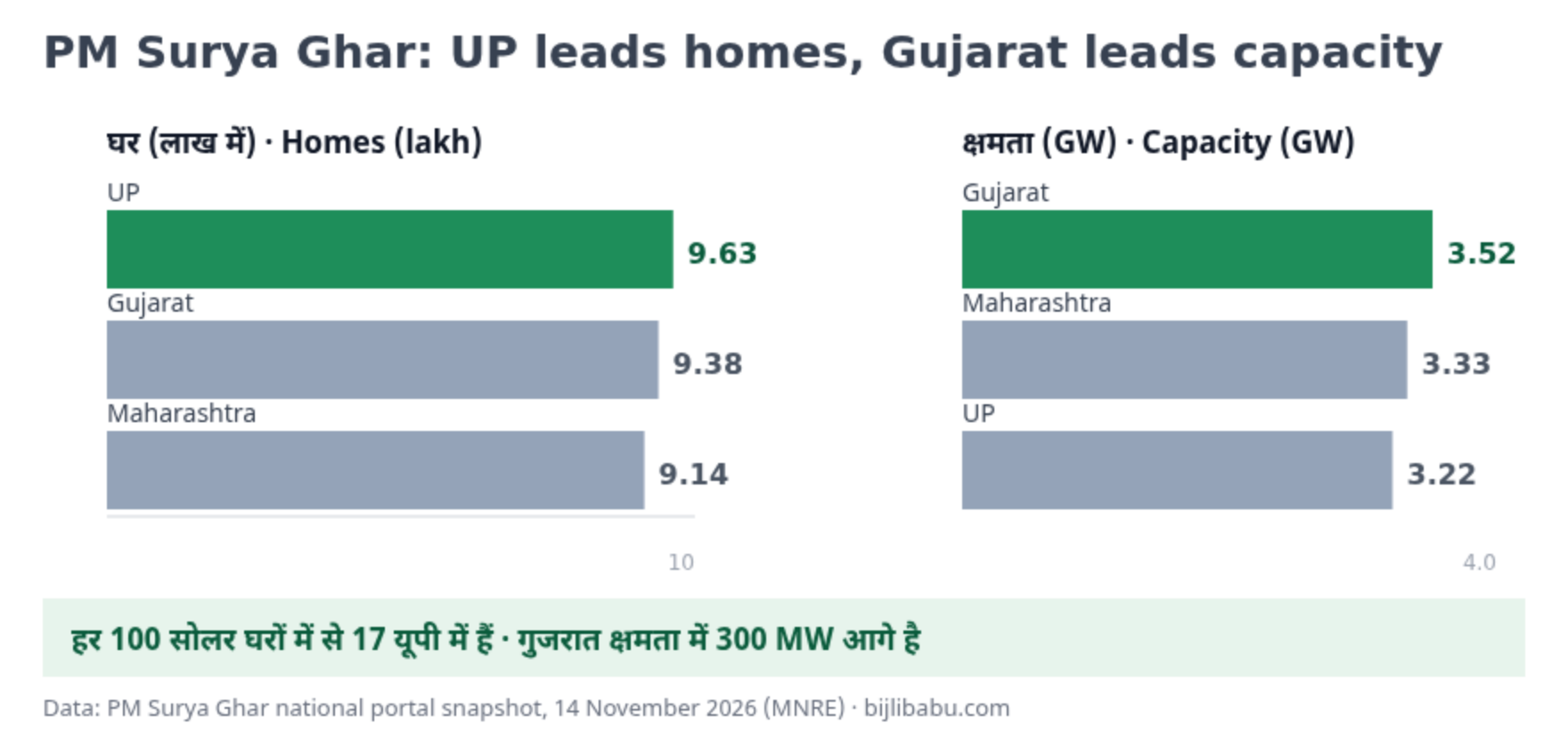
The scoreboard on 14 November
The national portal's snapshot for 14 November reads like this.
| State | Homes with solar | Capacity | Average system | Subsidy released |
| Uttar Pradesh | 9,62,866 | 3.22 GW | 3.35 kW | ₹6,510 crore |
| Gujarat | 9,38,087 | 3.52 GW | 3.75 kW | ₹6,820 crore |
| Maharashtra | 9,13,889 | 3.33 GW | 3.64 kW | ₹6,438 crore |
| India (all states) | 56,79,213 | 19.69 GW | 3.47 kW | ₹37,534 crore |
UP holds about 17 of every 100 solar homes in India. It has also received the most applications, 14,02,267, and it converts them at 68.7 percent against a national 62.8 percent. Families here are applying, and the state is finishing what it takes in faster than most.
Most homes, fewer kilowatts
Homes and kilowatts drift apart because plant sizes differ. A rooftop plant cannot be bigger than the sanctioned load printed on your bill. Roof area and the family's budget cap it further. The subsidy design pulls everyone towards 3 kW: you get ₹30,000 per kW on the first 2 kW, ₹18,000 on the third kW, and the support stops at ₹78,000 whether the plant is 3 kW or 10 kW. Buyers in Gujarat cross that 3 kW line more often than buyers in UP, so their average has climbed to 3.75 kW against UP's 3.35.
The money follows the kilowatts. Each Gujarat home has drawn ₹72,701 of subsidy on average, computed from the portal table, against ₹67,611 for a UP home. The national average is ₹66,090 per home. A bigger plant costs more to install, so a bigger subsidy per home is fair arithmetic, not favouritism.
Speed is where UP leads outright. Union Minister of State Shripad Naik told the Bharat Renewable Energy Summit this week that the time to complete 50,000 installations in UP has fallen from 270 days to 20. The pipeline behind that number has real steps: your application goes to the DISCOM, the vendor installs, the DISCOM fits a net meter, an inspection follows, and only then is the plant commissioned and the subsidy paid into your bank account. Cutting that cycle from months to weeks is why a record number of applications now ends in running panels instead of pending files.
What UP's panels actually produce
UPNEDA's statement of 8 November sets out the state ledger, figures as on 5 November. There were 9,53,201 plants then, carrying 3,167.57 MW. The estimate puts their output near 1.42 crore units a day. At ₹6.50 a unit, that is roughly ₹9.26 crore worth of electricity daily, close to ₹3,380 crore over a year, generated on houses instead of in a power plant.
The same statement counts ₹8,454.5 crore of subsidy already paid to UP households: ₹6,254.5 crore from the Centre and ₹2,200 crore from the state's top-up. It also lists what those roofs replaced. A ground-mounted plant of this size would have needed about 12,670 acres. The panels avoid an estimated 35 lakh tonnes of carbon dioxide a year. Behind them stand more than 8,700 empanelled vendors and over one lakh direct and indirect jobs.
October was the state's best month yet. UP added 75,031 homes, the highest in India, and 259.41 MW, ahead of Maharashtra's 236.66 MW and Gujarat's 215.59 MW. The three states together accounted for 43.7 percent of the 1,628 MW India added in October, a month that ran 18.4 percent ahead of September.
Where the scheme stands nationally
The portal counted 56,79,213 homes commissioned by 14 November, running 19.69 GW, with ₹37,534 crore of subsidy released. November has added 1,26,484 homes in its first 14 days. Mercom's tally on 13 November put the scheme near the 20 GW mark with ₹374.07 billion disbursed. The subsidy window closes on 31 March 2027.
The race is concentrated. RMI India Foundation's analysis notes that residential systems now make up more than 60 percent of India's total rooftop capacity, that over 70 percent of installations sit in six states, and that just 65 districts account for about half the country's installations. UP, Gujarat and Maharashtra are the top three of those six, so the national number moves wherever these three push.
What you should do
- Read the sanctioned load on your latest bill before you pick a size. The average UP home system is 3.35 kW, and yours cannot exceed your sanctioned load.
- Apply on pmsuryaghar.gov.in through a registered vendor using DCR panels. The subsidy reaches your bank account after commissioning; it is not a vendor discount.
- If you plan above 3 kW, size the plant for your own consumption, not for subsidy. The support stops at ₹78,000.
- Work out what net metering will actually return to you. Our net metering explainer covers the monthly netting and the 31 March settlement at ₹2 a unit, and the bill calculator does the arithmetic for your slab.
Sources
- PM Surya Ghar national portal data, snapshot 14 November 2026 (state table via Solentra tracker)
- UPNEDA statement, 8 November 2026, figures as on 5 November, reported by Hindusthan Samachar
- JMK Research October data, via The Hindu BusinessLine, 9 November 2026
- ETEnergyWorld: MoS Shripad Naik at the Bharat Renewable Energy Summit, November 2026
- Mercom India, 13 November 2026
- RMI India Foundation, Solarising India's Homes (PM Surya Ghar analysis)
- Subsidy slabs: pmsuryaghar.gov.in