
Dussehra is over. The bigger test is ahead: Diwali on November 8, then Chhath from November 13 to 16, when ghats stay lit through the night. The Uttar Pradesh government has told the power corporation to keep the supply running without breaks through all of it. Orders are out for 24-hour electricity in districts, tehsils and rural areas. Here is what UPPCL is doing on the ground, and what these weeks of heavy usage will do to your bill.
The order: power through the festival nights
The instruction to the discoms is blunt. Supply should run beyond the roster, in villages as well as cities, for the whole festival window. Chairman Ashish Kumar Goel has asked the managing directors of the discoms and the chief engineers to make sure temples, Shakti Peethas and other religious sites get power as per the timetable fixed for them. UPPCL MD Nitish Kumar said the preparation covers villages, cities, municipal corporation areas and municipalities.
The work behind the promise is routine, but it matters. All five discoms are doing preventive maintenance: Madhyanchal, Paschimanchal, Purvanchal, Dakshinanchal and KESCO in Kanpur. Lines and equipment are being serviced. Tree branches that touch wires are being cut back, because a branch resting on a line is the most common reason a feeder trips on a windy night. Teams in the Purvanchal region, which carries the heaviest Chhath load, are working round the clock.
If you live in a rural area, none of this means the roster has been scrapped for good. Rural feeders normally run on fixed hours, and that roster returns after the festivals. What UPPCL has ordered is supply beyond the roster for the festival window, so villages get light on Dussehra, Diwali and the Chhath nights like the cities do.
The demand behind the promise
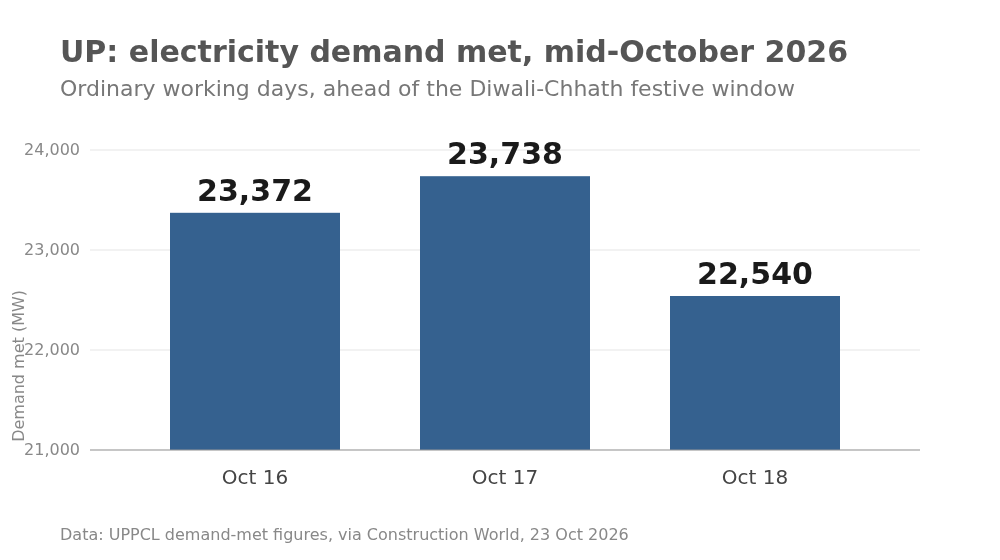
The pledge comes with numbers behind it. UPPCL says it met a demand of 23,738 MW on October 17, 23,372 MW on October 16 and 22,540 MW on October 18. Those were ordinary working days, not festival peaks. The corporation also says UP did better than Telangana, Tamil Nadu, Karnataka and Andhra Pradesh in meeting demand in this period.
| Day | Demand met (MW) |
| October 16, 2026 | 23,372 |
| October 17, 2026 | 23,738 |
| October 18, 2026 | 22,540 |
Festive weeks push the curve further. Decoration lighting burns for longer hours, and on Chhath the load near rivers and ponds stays up through the night. That is the period these preparations are aimed at.
What it means on your bill
More hours of supply usually means more units at home. Nothing on the tariff side has changed. The UPERC rates for FY 2026-27 stay where they were, and the FPPAS line works separately. October bills have actually carried a small relief there, a 5.24% cut in the fuel surcharge, which we explained in an earlier article. That adjustment applies to the fuel cost, not to your units, so festive usage is still billed at the slab rate.
The cost that surprises people is decoration lighting. Each bulb looks cheap, but old filament serial lights add up. Here is a worked example. It uses the indicative urban domestic rate of about ₹5.50 a unit for the first 150 units, and assumes the lights burn five hours a night from Dussehra to Diwali, about 20 nights.
| Lighting setup (5 hours a night, 20 nights) | Units added | Added cost at ₹5.50/unit |
| 10 LED bulbs of 8 W each | 8 units | ₹44 |
| 10 old filament bulbs of 40 W each | 40 units | ₹220 |
| The difference | 32 units | ₹176 |
If your monthly total crosses 150 units, the extra units cost about ₹6.00 each, so the same swap saves even more. Rural domestic slabs are lower. Your own bill is the final word, and you can estimate it in a minute with the UPPCL bill calculator.
What you should do before Diwali
First, if you are on a prepaid smart meter, recharge before the festival day, not on it. A balance running out on Diwali night is a self-inflicted outage. UPPCL's own notes mention a 2% rebate on the energy rate for prepaid smart meter consumers. The UPPCL SMART app also shows your daily usage, which is the easiest way to see what is eating your units.
Second, look at how your decoration lights are wired. Use LED strings, keep them on one plug point, and avoid joint wires and hooks on the pole outside. Most Diwali trips and fires start at that cheap extension, not at the substation.
If the power still goes off
Promises are one thing, a fallen line on a stormy night is another. If your area does go off, call 1912 or register the complaint on the UPPCL SMART app, and keep the complaint number. Teams are on duty through the festival window, so an early complaint usually means an earlier fix. If a complaint sits unattended for days, that number is what lets you escalate it at the subdivision office.
One more thing for Chhath. Ghats and riverside localities get supply priority during the arghya hours, and you may see teams testing generators near the ghats in the days before. If you live in one of these areas, plan heavy appliance use around the evening and morning arghya rather than alongside it.
Sources:
- Construction World, 23 Oct 2026: https://www.constructionworld.in/energy-infrastructure/power-and-renewable-energy/up-assures-uninterrupted-power-supply-during-festive-season/99263
- UNI, 19 Oct 2026: http://103.115.194.21/uninterrupted-power-supply-during-festivals-up-to-remain-illuminated-from-villages-to-cities-on-dussehra/north/news/4014126.html
- Energetica India: https://www.energetica-india.net/news/uttar-pradesh-promises-uninterrupted-power-supply-for-upcoming-festivals
- Festival dates: Drik Panchang (Chhath Puja 2026), News18 Chhath calendar
- Indicative FY 2026-27 domestic slabs: https://uppclbillcalculator.com/how-to-reduce-electricity-bill-in-up/