

The bill lands nearly double the usual amount. The appliances have not changed. The obvious suspect is the meter, and advisories doing the rounds this week, including an Aaj Tak explainer on 14 November, tell consumers to check it before complaining. What most people miss is that the UP Electricity Supply Code already gives you a formal meter test with fixed deadlines, and if the meter is genuinely faulty, UPPCL has to replace it and adjust your last three months' bills.
Here is the full path, from the checks at your meter to the test application at the sub-division office.
First, never touch the meter
The meter is sealed property of the discom. Break a seal or open the cover and your complaint turns into a tampering case, which ends in a theft assessment and penalty. Every check below uses switches only. Anything that needs a wire moved is a job for an electrician.
Three checks at home
The all-off test. Switch off every light, fan, TV, AC and geyser, leave the main switch on, and watch the meter's pulse light. A blink every few seconds is normal, because fridges, inverters and chargers cycle on their own. If the digits keep climbing steadily with the house dead, something is drawing power: a wiring leak or the meter itself.
The one-kilowatt hour test. This one is pure arithmetic, the identity behind every bill: power × time = energy. One thousand watts is 1 kW, and 1 kW running for one hour uses exactly 1 kWh, which is the unit your meter counts. Take a 1 kW load, an iron, a geyser or a heater, run it for a timed hour, and note the reading before and after. About 1 unit is healthy. If the meter adds 1.2 units, it is roughly 20 per cent fast; if it adds 0.8, it is slow. Treat this as an indication only, since the official test result is what changes a bill.
The paper trail. Put the last three to six bills side by side and check the units column before the rupees. An estimated reading, an arrears line or a 35-day billing period can explain a jump that feels like a fast meter. On a smart meter, compare the app's consumption data with the meter display. You can also recompute the bill from the billed units on the bijlibabu bill calculator before deciding the meter is wrong.
The official meter test, and the deadlines that bind UPPCL
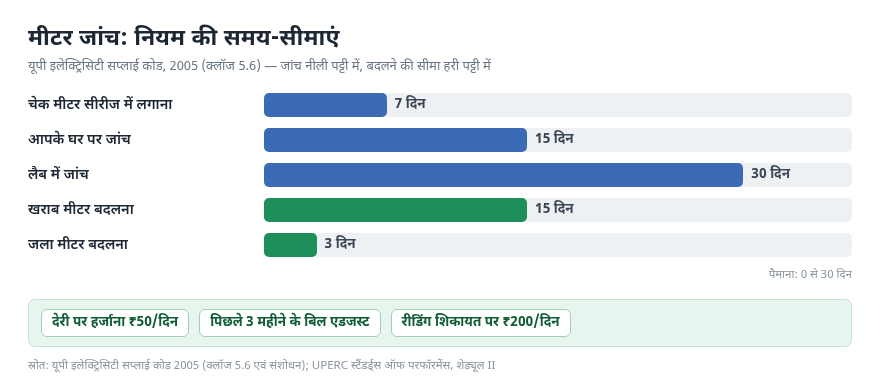
If the checks leave doubt, clause 5.6 of the UP Electricity Supply Code, 2005 gives you the test as a right. You apply in the prescribed form, Annexure 5.1, at your sub-division office with the testing fee, and you are allowed to be present during the test. The Code sets three ways to test a meter and a deadline for each:
| Rule point | Deadline or limit |
| Test at your premises after written application | 15 days |
| Test at the discom's or an independent lab | 30 days |
| Tested check meter installed in series with yours | 7 days |
| Minimum consumption for a premises test | 1 kWh |
| Replacement of a defective meter after the test report | 15 days |
| Replacement of a burnt meter | 3 days |
| Bills adjusted as per the test result | Previous 3 months |
| Recovery if the meter is found slow | Max 3 instalments |
| Compensation when replacement is delayed | ₹50 per day |
| Compensation for a meter reading complaint | ₹200 per day |
At your premises, the testing team carries a heating load and runs the meter for at least 1 kWh. The discom's own meter complaint form asks for the problem in exactly these words: burnt out, completely stopped, fast, seal broken, or testing of meter.
If the meter is found fast
The Code then works in your favour. A new meter goes in within 15 days, and the bills of the previous three months, counted before the month you filed the dispute, are adjusted in your next bill as per the test result. The arithmetic on a real case: a meter 20 per cent fast on a home truly using 150 units gets billed 180 units. Those 30 phantom units fall in the ₹6.00 slab for urban domestic consumers (151 to 300 units in the FY 2026-27 notice; rural homes pay ₹5.00 in that band), so the fast meter has been adding about ₹180 a month, roughly ₹540 across the three-month window the Code asks UPPCL to refund or adjust.
If you dispute the test result, you do not have to accept it. The discom installs a fresh tested meter, seals the disputed one in your presence and sends it to its lab, an independent lab or the Electrical Inspector, whichever you choose. The lab report binds both sides. Replacement carries teeth: UPPCL's Supply Code amendment allows 15 days after the test report for a defective meter and 3 days for a burnt one, and UPERC's standards of performance add ₹50 per day compensation for the delay, with ₹200 per day for meter reading complaints. Both apply to consumers with no arrears. Once a meter is declared defective, revised bills may carry codes such as IDF or RDF; here is what those defective bill codes mean.
If the test says the meter is fine
The fee stands and so does the bill. At that point the problem is reading or billing, not the meter: file it on 1912 or at the section office and keep the complaint number. If it stalls, the Consumer Grievance Redressal Forum and then the Electricity Ombudsman are the next stops.
What you should do
- Photograph the meter with today's reading and keep the last three bills ready before you file anything.
- Submit the Annexure 5.1 application in writing, pay the fee against a receipt, and take a complaint number the same day.
Sources
- Aaj Tak explainer on checking a suspect electricity meter, 14 November 2026: https://www.aajtak.in/information/story/electricity-meter-running-fast-high-bill-check-and-complaint-rttw-dskc-2693092-2026-11-14
- UP Electricity Supply Code, 2005, clause 5.6 (defective meters), as reproduced in a Allahabad High Court judgment: https://dailylaw.ai/d/2017-dailylaw-2926-all
- UPPCL, Electricity Supply Code amendment (replacement deadlines, compensation condition): https://uppcl.org/site/writereaddata/siteContent/202511201623012790Amendment_1.pdf
- UPERC Standards of Performance Regulations, Schedule II (₹50 per day, ₹200 per day compensations): https://upload.indiacode.nic.in/showfile?actid=AC_UP_88_456_00007_00007_1760515272954&filename=standard_of_performance_word_nw_pdf.pdf&type=regulation
- UPPCL public notice, approved tariff FY 2026-27 (urban and rural LMV-1 slabs): https://dvvnl.org/UploadFiles/tariffPlan/Press%20English_FY%202026-27.pdf
- Meter complaint form on the UPPCL consumer portal: https://consumer.uppcl.org/wss/assets/pdfs/download_forms/en/dvvnl/Meter_Related.pdf


