Walk through your home tonight and count the little lights: the red dot on the TV, the green glow on the set-top box, the dim clock on the microwave, the charger idling in the socket though no phone is attached. Every one of those is a device that is "off", and it is still billing you. Electricity that appliances draw while switched off or idle is called phantom load, or standby power, and in a typical UP home it quietly adds ₹480–570 a year to the bill. Here is how to find it and switch it off for good.
What phantom load actually is
Modern appliances never fully switch off. A television in "off" state still listens for the remote; a set-top box keeps its channel memory and display alive; a microwave powers its clock; a phone charger stays warm in the socket. This idle draw is small — usually under a watt per modern device — but it runs 24 hours a day, all year.
The arithmetic is unforgiving. One watt of continuous standby consumes about 9 kWh of electricity a year. At UPPCL's urban domestic (LMV-1) energy charges for FY 2026-27 — ₹5.50–₹6.50 per unit, unchanged for the fifth consecutive year — that single watt costs you ₹48–₹57 annually. A watt is tiny; a year is not.
How big is the leak?
Regulators have spent two decades shrinking this. Under the IEA's One-Watt Initiative, most developed countries capped new devices at 1 watt of standby (0.5 W from 2013), and a modern HD LED television may draw less than 1 W when off. But older devices — and India's homes are full of second televisions, aging set-top boxes and old microwaves — can idle at 10–15 W each.
Before such rules, standby draw reached 8–22% of appliance consumption in different countries — roughly 3–10% of total household electricity. A UP home that uses 200 units a month (2,400 kWh a year) carrying just 10 W of phantom load is leaking 87.6 kWh a year — about 3.7% of its consumption, right inside that verified range.
What it costs at UPPCL rates
Take a realistic mix: an older set-top box, a TV left on standby, a router that never sleeps, a couple of chargers living permanently in the socket — call it 10 W of continuous idle draw. Over a year that is 87.6 kWh, billed at your slab rate:
| Standby draw in the home | Units wasted/year | Cost/year @ ₹5.50 (0–150 slab) | Cost/year @ ₹6.50 (300+ slab) |
| 5 W (modern devices only) | 43.8 kWh | ₹240.90 | ₹284.70 |
| 10 W (typical mixed home) | 87.6 kWh | ₹481.80 | ₹569.40 |
| 15 W (older set-top box era) | 131.4 kWh | ₹722.70 | ₹854.10 |
(Fixed charges don't change — this is pure wasted energy charge.)
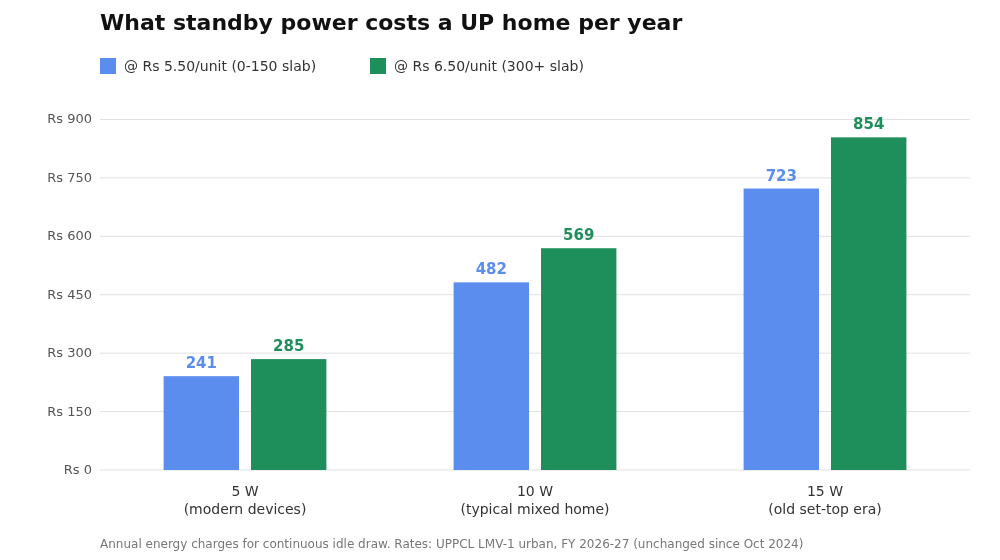
Roughly ₹40–47 a month for nothing. Not a bill-breaking amount, but it is the easiest money you will ever save, because the appliance does nothing for you while drawing it.
What you should do
1. Switch off at the socket, not the remote. Indian switchboards make this trivially easy — every board has individual switches. TV, set-top box, geyser, microwave: kill the socket when you leave the room for the night. The one exception worth noting: your Wi-Fi router, which you generally want running 24×7 — that is working load, not phantom load.
2. Unplug idle chargers and use a switched power strip. A charger warm to the touch is consuming power. Cluster the entertainment-unit devices (TV, set-top box, speakers, console) on one switched strip and make "strip off" the last act before bed. If you want proof before you change habits, a cheap plug-in energy meter will show you each device's idle draw in watts.
When you next buy a TV, AC or set-top box, check the standby rating on the spec sheet — under 0.5 W is the standard to ask for. And to see what any of these savings do to your actual bill, recompute it in the Bijlibabu Bill Calculator before and after.
The bottom line
Phantom load is the rare bill problem that costs nothing to fix. The wattages are small, but they run 8,760 hours a year — and at ₹5.50–₹6.50 a unit, UP's tariffs charge you for every one of those hours. Flip the socket switch tonight; the saving starts immediately and shows up on your very next bill.
Sources: Standby power — Wikipedia (IEA One-Watt Initiative figures; US DOE device data; OECD residential-share studies); UPPCL/MVVNL tariff rate schedule FY 2026-27 via Bijlibabu Rate Schedule (rates unchanged since Oct 2024).