
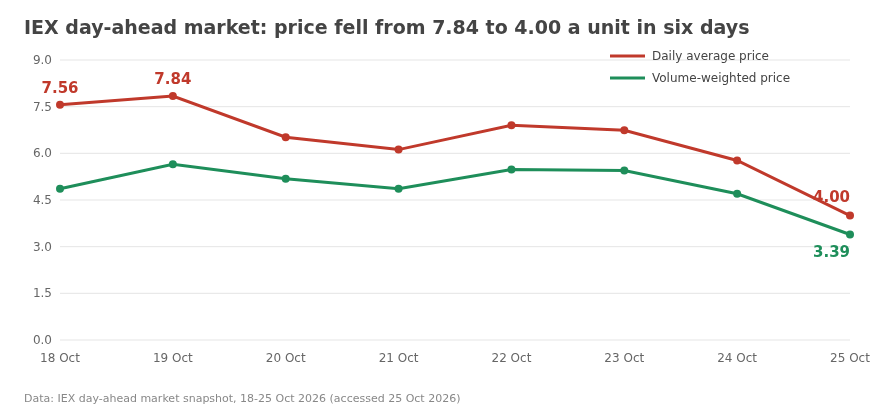
In September, power was so tight that utilities in Uttar Pradesh were paying the exchange ceiling of ₹10 a unit for around 16 hours a day. This week, the same market has been clearing at a fraction of that. The day-ahead price on the Indian Energy Exchange (IEX) for delivery on 25 October works out to ₹4.00 a unit, against ₹7.84 on 19 October. That is a fall of about 49% in six days.
The wholesale price never appears on your bill directly. But it decides what your discom pays for the extra power it buys when long-term contracts fall short, and that cost comes back to consumers with a lag through the FPPAS adjustment. So this dip matters, just not immediately.
What the power exchange is
Most electricity moves under contracts signed years in advance. A generator commits a fixed quantity at a fixed rate, and the discom lifts it every day. The exchange handles the leftover. When a discom falls short in the evening, or a generator has surplus after its contracted buyers have taken their share, the gap is filled on IEX.
The day-ahead market (DAM) is the main segment. Buyers and sellers submit bids for the next day, split into 96 blocks of 15 minutes each. The exchange matches them and settles on one clearing price per block: every accepted seller gets it, every accepted buyer pays it. When buyers are desperate, bids climb to the ₹10 ceiling. When supply is comfortable, the price sags. The real-time market (RTM) works the same way but settles much closer to delivery, so discoms use it to patch sudden gaps.
Short-term trade is still the smaller part of the business. Exchanges and other short-term routes carried 13.03% of the electricity generated in the country in 2024-25, up from 9.6% in 2009-10, the Indian Express reports. But it is where the costliest unit of the day gets bought, so it shapes the margin of every discom's power purchase bill.
The week in numbers
Here is what the IEX day-ahead market looked like over the past eight days.
| Date (October 2026) | Average day-ahead price (₹/unit) | Volume-weighted price (₹/unit) | Power cleared (MU) |
| 18 | 7.56 | 4.86 | 145.75 |
| 19 | 7.84 | 5.65 | 172.18 |
| 20 | 6.52 | 5.18 | 144.43 |
| 21 | 6.12 | 4.86 | 151.08 |
| 22 | 6.90 | 5.48 | 163.76 |
| 23 | 6.74 | 5.45 | 164.92 |
| 24 | 5.77 | 4.70 | 175.06 |
| 25 | 4.00 | 3.39 | 160.85 |
Two things stand out. The average price fell from ₹7.84 a unit on 19 October to ₹4.00 on 25 October, down about 49%. The volume-weighted price, which weights each 15-minute block by the power actually traded, fell from ₹5.65 to ₹3.39. And the volume did not dry up: buyers lifted 145 to 175 million units (MU) a day through the week. This was a genuine price fall, not a market running out of buyers.
Why prices cooled
The weather turned. Peak demand across the country stayed below 250 GW through the second half of October, after crossing 260 GW on 5 and 8 October, the Indian Express reported on 22 October. September had peaked at 269 GW on the 10th. Cooler evenings mean fewer fans and air conditioners running, and the festival season has slowed factories.
Sellers noticed. Sell bids in the day-ahead market rose 23% between 1 and 21 October compared with the same period in September, while buy bids slipped 1%. More sellers chasing fewer buyers drags the clearing price down. Nationally, the average DAM price for 1 to 21 October was ₹7.6 a unit against ₹7.8 in September. In the real-time market it fell around 14%, to ₹6.7.
There is a warning inside the good news. Coal stocks at thermal plants slid to 17.5 million tonnes as of 21 October, from 18.6 million tonnes a month earlier and around 55 million tonnes at the start of April. Hydropower output is down 12.88% this financial year, so coal has been working harder; generation from coal plants rose 12.05% between 1 April and 18 October. If demand swings back up while stocks keep thinning, exchange prices can shoot up again just as fast.
How this reaches your UP bill, with a lag
Your unit rate comes from the UPERC tariff order and does not move with the exchange. What the exchange changes is the cost of the power UPPCL buys outside its contracts, and that cost is passed through the FPPAS mechanism. Every month, UPPCL compares its actual power purchase and transmission cost of three months earlier with the approved cost, and bills are adjusted by the difference. We explained the working in detail in The 5.24% line on your October UPPCL bill.
July's purchases cost ₹4.69 a unit against the approved ₹4.94, so October bills carry a 5.24% reduction, worth about ₹424 crore across the state. It is the fourth straight month of relief: 4.43% in July, 2.92% in August and 7.93% in September.
September itself was expensive, and that is the part to watch. UPPCL told KNN India that UP faced a shortfall of 1,500 to 2,000 MW, that exchange power sat at the ₹10 ceiling for about 16 hours a day, and that rural areas saw limited night cuts. Under the three-month rule, those September costs will surface in December bills. October's cheap prices, if they hold, will show up in the January calculation.
What you should do
- Check the FPPAS line on your October bill. It should show the 5.24% reduction on the fuel adjustment. If it is missing, raise it with your subdivision office or on 1912.
- Do not expect the exchange price on your meter. Your slab rates stay as approved, and relief arrives only through the FPPAS line, three months after the cost is incurred. Estimate your bill with our bill calculator, and keep an eye on the December bill, which will carry September's costly purchases.
The dip in the exchange price is real, and for once it points the same way as the FPPAS line on your bill: down. Whether it stays there depends on coal stocks and the weather over the next few weeks.
Sources
- IEX, day-ahead market snapshot, 18 to 25 October 2026 (accessed 25 October 2026): iexindia.com
- The Indian Express, "A breather for spot power prices, but coal stocks at plants continue to decline", 22 October 2026: indianexpress.com
- KNN India, "UP faces 1,500-2,000 MW power shortfall amid coal supply disruptions", 16 September 2026: knnindia.co.in
- The Financial Express, "Power crunch turns into cost squeeze for discoms", October 2026: financialexpress.com
- CNBC-TV18, "UP electricity consumers to get 5.24% relief in October bills", 30 September 2026: cnbctv18.com