Every solar rooftop in UP shares one weakness. It works hardest at noon and switches off by evening, which is exactly when the state's demand touches its peak. UPRVUNL, the state's generation company, now wants to fix part of that with batteries. On 27 October it detailed a plan to build battery energy storage systems (BESS) at six of its thermal power stations, with a combined capacity of 4,250 MW and an estimated cost of ₹5,525 crore. A feasibility study by IIT-BHU, commissioned by UPRVUNL, identified the potential. Managing director Mayur Maheshwari said the batteries would help the state manage peak demand, improve supply during evening and night, and cut dependence on costly purchases from the market.
What has been proposed
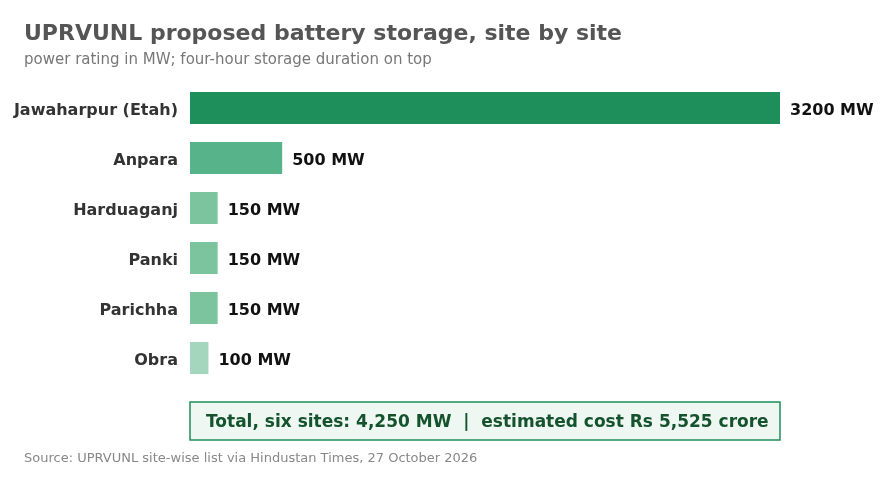
The six sites are existing UPRVUNL stations, and Jawaharpur in Etah carries the largest share by a wide margin.
| Station | Battery planned | Investment |
| Jawaharpur (Etah) | 3,200 MW | ₹4,160 crore |
| Anpara | 500 MW | not stated |
| Harduaganj | 150 MW | not stated |
| Panki | 150 MW | not stated |
| Parichha | 150 MW | not stated |
| Obra | 100 MW | not stated |
| Total, six sites | 4,250 MW | ₹5,525 crore |
The arithmetic holds together. At the top of the stated cost band of ₹1.25 to ₹1.3 crore per MW, 4,250 MW works out to ₹5,525 crore, and Jawaharpur's 3,200 MW at the same rate gives ₹4,160 crore, leaving ₹1,365 crore for the other five sites.
One unit note before going further. Some reports have printed the same figure as MWh. The site-wise list quoted by UPRVUNL officials is in MW, and a four-hour storage duration sits on top of it. Treat 4,250 MW as the power rating and the four hours as how long it can hold that output.
Why batteries are going up next to coal stations
Batteries and coal stations are not an obvious pair, but the site choice is practical. These stations already have land, switchyards and power evacuation lines, so a battery block added there connects to the grid without fresh land acquisition or new transmission. UPRVUNL estimates 1.5 to 2 acres of space for every 100 MW of storage.
The timing logic comes from how UP's day looks to a grid operator. Through the afternoon, availability runs ahead of demand, and solar adds to the surplus. After sunset the pattern flips: demand peaks, solar drops to zero, and available power falls short, especially in summer. Maheshwari said the systems would store electricity from the thermal stations and, when available, from solar, and release it during peak hours. One full four-hour cycle across all six sites can shift about 17,000 MWh, or roughly 1.7 crore units, from the afternoon to the evening.
The technology, in plain terms
The plan specifies lithium iron phosphate (LFP) chemistry with liquid cooling, designed for four hours of storage and a single daily cycle. LFP is the standard choice for grid batteries worldwide because it handles daily deep cycling, runs cooler than other lithium chemistries, and lasts longer, at some cost in compactness. Liquid cooling keeps the cells in a narrow temperature band, which is what protects their life in Indian summers.
Costing is proposed to follow CERC guidelines. The stated band of ₹1.25 to ₹1.3 crore per MW is in line with what battery storage has been clearing at in India recently, so the numbers are not fanciful, though a feasibility study's estimates and a tender's discovered price are different things. This is still a plan. No tender has been floated, and no sanction announced.
How big is this for UP
The Central Electricity Authority's resource adequacy report for 2026-27 to 2035-36 projects that UP needs to add 52,977 MW of energy storage over the period. UPRVUNL officials put their 4,250 MW at around 8 percent of that requirement. The comparison is fair as far as it goes, and 8 percent from one utility's own sites is a reasonable opening contribution.
There is already one live battery procurement to measure against. On 8 October, UPERC adopted tariffs of ₹6.45 to ₹6.46 per unit for a 375 MW / 1,500 MWh battery system that will feed evening peak power to UPPCL. That approved system is a fraction of the proposed one, and its discovered tariff gives consumers a reference point: storage is entering UP's supply mix at under ₹6.50 a unit for the energy service it provides. Whether the UPRVUNL projects, if tendered, land cheaper or costlier will depend on bidding.
What it means for solar users
For the state's solar story, batteries are the missing half. Rooftop solar has crossed 9 lakh installations in UP, and every unit exported at noon is worth less to the grid than a unit delivered at 8 pm, because that is when power is actually scarce. Storage is what converts abundant afternoon solar into evening supply. A 4,250 MW fleet of batteries, if built, gives solar room to keep growing without the evening gap widening.
On your own roof, the lesson is the same at a smaller scale. The cheapest battery is your own house: run the washing machine, motor or AC load in the afternoon when your panels are producing, and you keep units that would otherwise be exported at a low value. Our rooftop solar and net metering explainer covers how the billing works month to month.
What you should do
If you have rooftop solar, time your heavy loads to the afternoon. Self-consumed units displace grid purchases at the full slab rate, which beats exporting them at the net metering rate.
And keep an eye on the next steps of this plan. A feasibility study of October becomes a consumer cost only through a tender and a UPERC approval, both of which happen in public. If the projects are tendered in 2027, the bids and the adopted tariff will show what evening storage really costs in UP, and that cost will eventually find its way into purchase-cost adjustments.
Sources
- Hindustan Times, 27 October 2026: "UP plans ₹5,525-crore battery storage projects at six locations" (IIT-BHU study, site-wise list, MD Mayur Maheshwari and Sanjay Gupta quotes), https://www.hindustantimes.com/cities/lucknow-news/up-plans-5-525-crore-battery-storage-projects-at-six-locations-101793039445579.html
- KNN India, 27 October 2026, https://www.knnindia.co.in/news/newsdetails/state/up-power-utility-plans-4250-mw-battery-storage-projects-at-six-locations-with-rs-5525-crore-investment
- Power Peak Digest on the UPRVUNL BESS plan, https://powerpeakdigest.com/uprvunl-4250mw-battery-storage-projects-up/
- UPERC order dated 08.10.2026 in Petition No. 2403 of 2026 (375 MW/1,500 MWh BESS tariff adoption), https://www.uperc.org/App_File/Pt-no-2403of2026UPPCL-08-10-2026-PDF108202674640PM.pdf
- CEA Resource Adequacy Report for UP, 2026-27 to 2035-36, as quoted in the Hindustan Times report